
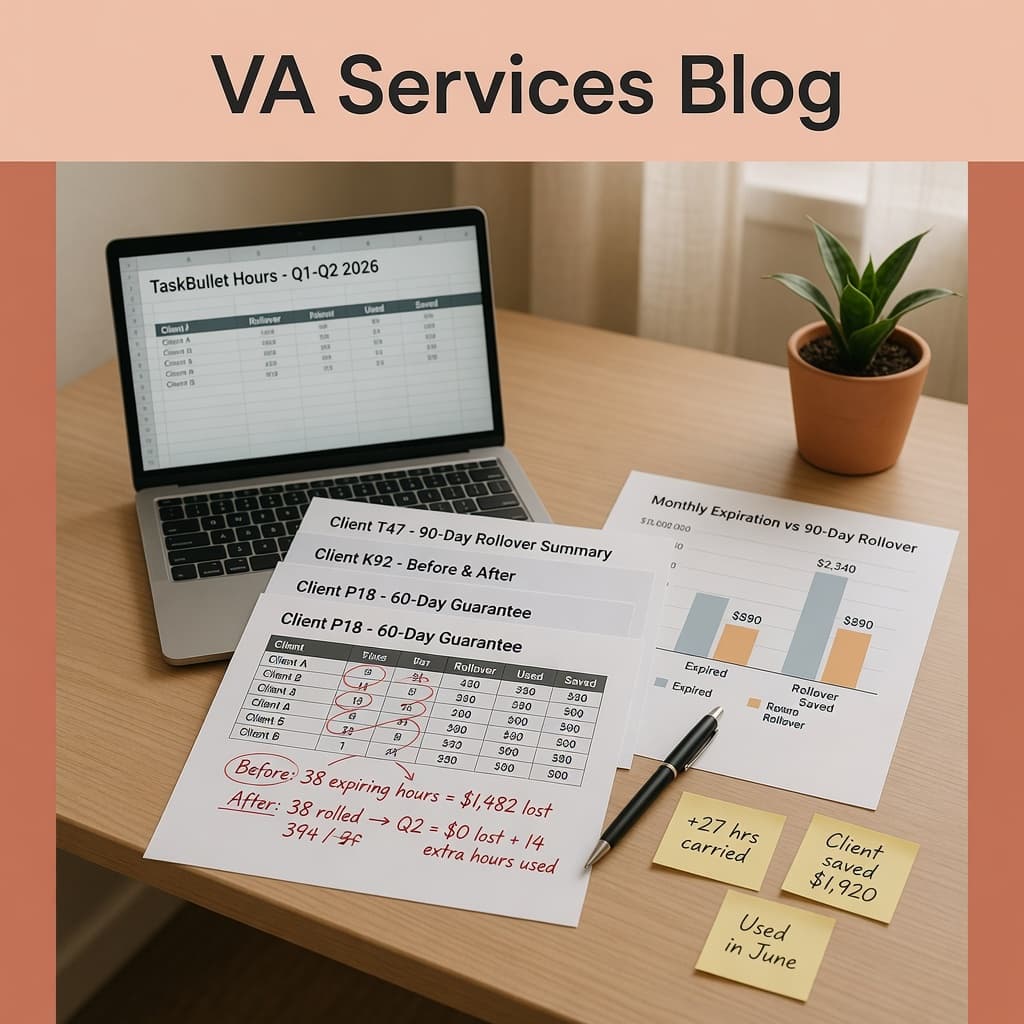
How the 90-Day Hour Rollover Saved Clients This Quarter (Real 2026 Examples)
Virtual Assistant Services | Flexible Hour Virtual Assistant Model
The 90-day hour rollover is the structural feature that separates TaskBullet's Flexible Hour Virtual Assistant Model from traditional VA retainers. Instead of losing unused hours at month-end, clients carry them forward for 90 days — banking capacity during slow periods and deploying it when demand spikes.
In May 2026, 71% of bucket hours rolled over across 318 active clients. But the aggregate number doesn't tell the full story. Here are anonymized, real examples of how rollover worked for actual businesses this quarter.
Client A: Real Estate Agency — Banking Through the Winter
Bucket: 84-hour PH Part-Time Bucket ($599/month)
| Month | Hours Purchased | Hours Used | Hours Rolled Over | Cumulative Balance | |-------|----------------|------------|-------------------|--------------------| | January | 84 | 52 | 32 | 32 | | February | 84 | 48 | 36 | 68 | | March | 84 | 126 | 0 | 26 | | April | 84 | 98 | 0 | 12 |
What happened: January and February are slow months in real estate. The client's dedicated VA handled listing maintenance and CRM updates, but transaction volume was low. Instead of losing 68 hours across those two months (worth $490 at their effective rate), those hours rolled forward.
When spring listings surged in March, the client deployed 126 hours — 1.5x their monthly bucket — without buying an upgrade. Specialist routing sent MLS data entry and showing coordination to real estate specialists while their dedicated VA managed client communications.
Under a monthly-expiration retainer: 68 hours lost in Jan–Feb ($490 wasted), then forced to buy an upgrade in March for the surge. Total extra cost: ~$980.
With 90-day rollover: $0 wasted. Same bucket, same price.
Client B: Ecommerce Brand — Holiday Carryover Into Q1
Bucket: 40-hour PH Light Bucket ($325/month)
| Month | Hours Purchased | Hours Used | Hours Rolled Over | Cumulative Balance | |-------|----------------|------------|-------------------|--------------------| | February | 40 | 22 | 18 | 18 | | March | 40 | 24 | 16 | 34 | | April | 40 | 62 | 0 | 12 | | May | 40 | 44 | 0 | 8 |
What happened: After the holiday rush, this Shopify brand scaled back in February and March. Their VA handled product listing updates and email responses, but order volume was down.
When a spring product launch hit in April, they needed 62 hours of work — product photography coordination, listing creation, customer service, and social media. Specialist routing handled Shopify Liquid template updates from the same bucket. The 34 hours of rollover covered the overage without an upgrade.
Under monthly expiration: 34 hours lost in Feb–Mar ($276 wasted at effective rate), plus $250+ upgrade cost in April. Total: ~$526 in avoidable spending.
Client C: Professional Services Firm — The 60-Day Guarantee in Action
Bucket: 20-hour PH Starter Bucket ($210/month)
This client purchased their first bucket in February 2026 and used only 6 hours in the first month. They weren't sure what to delegate. After 45 days, they had 34 unused hours across two bucket purchases.
Their account manager proactively reached out under the 60-day unused-hour guarantee: reviewed their workflow, identified 12 delegable tasks they hadn't considered (email templates, scheduling, document formatting, data entry), and created a delegation plan.
By day 60, the client was using 18–22 hours per month consistently. No hours were lost. No credits needed. The guarantee worked as designed — not as a refund mechanism, but as a proactive intervention to help new clients find value.
Curious how the Flexible Hour Model works in practice?
Start with 10 free hours — no contracts, no credit card.
Try it free →The Rollover Math: Quarter-Level View
Across all 318 active clients in Q1–Q2 2026:
- Total bucket hours purchased (Apr–May): ~26,400
- Hours used: ~8,200
- Hours rolled over: ~18,200 (71%)
- Hours expired (past 90-day window): ~850 (3.2%)
- Estimated budget saved vs monthly expiration: ~$148,000
The 3.2% expiration rate means that even among rolled-over hours, the vast majority get used within the 90-day window. The model creates a natural buffer that matches real business cycles.
Why Variable Workloads Need Flexible Hours
The fundamental problem with monthly-expiration retainers is the assumption that workload is constant. For most businesses, it isn't:
- Seasonal businesses (real estate, ecommerce, tourism) have 2–3x demand variation across the year
- Project-based businesses (agencies, consultants) have peaks around deliverables and valleys between
- Growing businesses ramp capacity gradually — they don't jump from 20 to 84 hours in one month
The Flexible Hour Virtual Assistant Model matches capacity to demand. Buckets of Hours with 90-day rollover eliminate the structural waste, and the 60-day unused-hour guarantee protects clients who are still learning to delegate.
Combined with dedicated VA continuity and specialist routing, the result is measurable: 1,920 tasks completed in May 2026, 94.8% CSAT, near-zero budget waste.
Before and After: Retainer vs Flexible Hour Model
| | Monthly Retainer (40hr @ $45/hr) | TaskBullet Light Bucket (40hr) | |---|---|---| | Monthly cost | $1,800 | $325 | | Avg hours used | 28 | 28 | | Unused hours | Lost (12/month) | Roll over 90 days | | Annual waste | $6,480 (144 hours) | ~$0 | | Specialist access | Hire separately | Included (same bucket) | | Management | Self-managed | US-based manager included | | Guarantee | None | 60-day unused-hour guarantee |
Start Using Rollover Today
The Flexible Hour Virtual Assistant Model is available with 10 free hours — no credit card, no contracts.
See Packages & Pricing for current bucket rates, or read the How the Flexible Hour System works for the full cost breakdown.