
Virtual Assistant for Small Business: Complete 2026 Guide
Small business owners wear every hat. Marketing, operations, customer service, bookkeeping, scheduling — the administrative load alone consumes 15–20 hours per week. That's 15–20 hours not spent on sales, growth, or the work that actually matters.
A virtual assistant handles the operational load at a fraction of the cost of a full-time employee. This guide covers what small business VAs actually do, what they cost, which hiring model works for growing businesses, and how to start delegating effectively.
The Small Business VA Opportunity
The math is simple:
- Average small business owner spends 16 hours/week on admin tasks
- Cost of admin time at $50/hour owner value = $800/week in lost productivity
- Cost of a VA at $10.50–$27/hour = $168–$432/week for the same 16 hours
- Net gain: $368–$632/week in recovered productive time
Over 12 months, that's $19,000–$32,000 in recaptured value — from a $10,000–$20,000 annual investment. The ROI compounds because the recovered hours go into revenue-generating activities.
Top Tasks Small Businesses Delegate
Administrative (5–10 hrs/week)
- Email inbox management and response drafting
- Calendar and appointment scheduling
- Travel coordination and booking
- Document preparation and formatting
- File organization and cloud storage management
Customer Operations (3–8 hrs/week)
- Responding to customer inquiries (email, chat, phone screening)
- Order confirmation and shipping updates
- Review management and response drafting
- Customer onboarding sequences
- Follow-up and retention outreach
Financial and Data (3–5 hrs/week)
- Invoice preparation and follow-up
- Expense categorization and receipt tracking
- Basic bookkeeping and reconciliation
- CRM data entry and cleanup
- Report generation and dashboards
Marketing (3–8 hrs/week)
- Social media content scheduling and engagement
- Email newsletter creation and distribution
- Blog post formatting and publishing
- Google Business Profile management
- Basic graphic design for social and email
Project Coordination (2–5 hrs/week)
- Vendor communication and follow-up
- Task tracking and deadline management
- Meeting notes and action item distribution
- Research and competitive analysis
Choosing the Right VA Model for Your Business
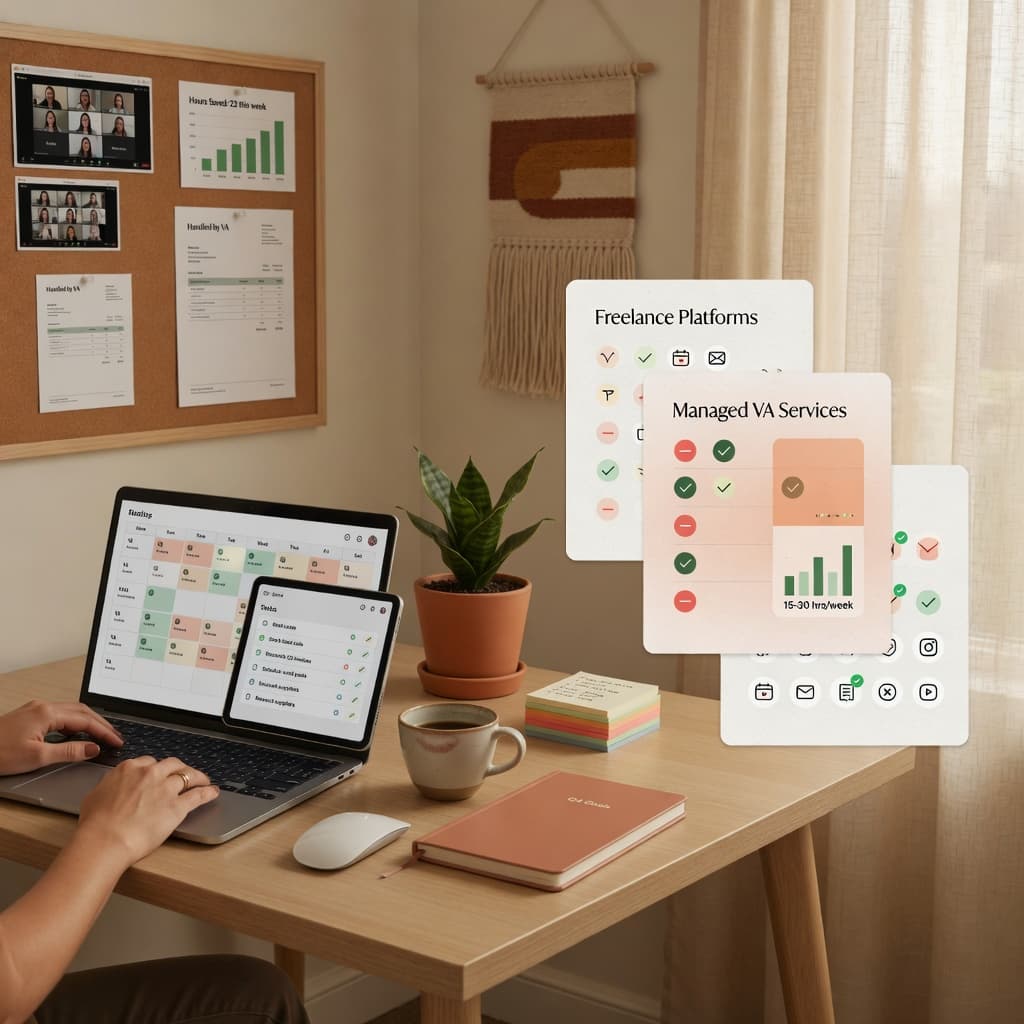
Freelance VA
Monthly cost: $400–$1,200+ (at 20–40 hrs) What you get: An independent contractor you find, hire, train, and manage yourself.
| Pro | Con | |-----|-----| | Lowest per-hour rate | You manage hiring and onboarding | | Flexible scheduling | No specialist backup | | No commitment | No quality oversight | | | Replacement risk (avg tenure 4–8 months) | | | 3–5 hours/week managing the VA |
Traditional Retainer
Monthly cost: $500–$2,500+ What you get: One dedicated VA on a fixed monthly hour plan.
| Pro | Con | |-----|-----| | Consistent assistant | Hours expire monthly | | Predictable cost | Single skill set | | | Often requires contract | | | You still manage performance | | | No specialist routing |
Managed Flexible Hour (TaskBullet)
Monthly cost: $210–$3,900 (scales by need) What you get: Dedicated VA + specialist routing + dedicated management + hour protection.
| Pro | Con | |-----|-----| | Dedicated VA continuity | Higher per-hour rate than some freelancers | | Specialist routing (same bucket) | | | US-based account manager included | | | 90-day hour rollover | | | 60-day unused hour guarantee | | | No contracts — cancel anytime | | | 10 free hours to test | |
For most small businesses, the managed model pays for itself in three ways: recovered owner time, eliminated management overhead, and zero wasted hours from cyclical workload variation.
→ Compare all three models in detail
Curious about flexible hours for your small business?
Start with 10 free hours — no contracts, no credit card.
Try it free →The Small Business Scaling Pattern
Most successful small business VA engagements follow the same trajectory:
Month 1: Foundation (10–20 hours)
- Email management, calendar scheduling, basic data entry
- Establish communication cadence in Basecamp
- Define standard operating procedures for 3–5 core tasks
Month 2: Expansion (20–40 hours)
- Add customer service responses and CRM management
- Start social media scheduling and email newsletters
- Introduce bookkeeping and invoice follow-up
Month 3: Optimization (30–60 hours)
- Full operational delegation
- Specialist routing for graphic design, web updates, or technical tasks
- Owner time fully redirected to growth activities
Month 6+: Strategic Delegation (40–84+ hours)
- VA handles all recurring operations independently
- Proactive task identification by VA (they know the business)
- Owner focuses exclusively on sales, strategy, and relationships
This progression works because the Flexible Hour Model's bucket system lets you start small and scale without changing plans or renegotiating contracts.
What About AI? Does Your Business Still Need a VA?
AI tools (ChatGPT, Jasper, automation platforms) handle some administrative tasks, but they don't replace a skilled VA for three reasons:
- Context and judgment — AI can draft emails, but a VA who knows your business, clients, and preferences drafts the right emails.
- Multi-system execution — AI can generate a marketing plan, but a VA logs into your CRM, social accounts, email platform, and actually executes it.
- Relationship management — Customer follow-up, vendor coordination, and partner communication require human judgment and social intelligence.
The best approach: your VA uses AI tools to work faster. They leverage ChatGPT for first drafts, automation for repetitive workflows, and their human judgment for everything that requires context. The managed model ensures someone is actually overseeing this — not just running AI outputs unchecked.
Start With 10 Free Hours
The fastest way to test whether a VA fits your business is to try it:
- Claim your 10 free hours — no credit card, no contract
- Complete a 15–20 minute welcome call to identify your first delegation tasks
- Start delegating within 48 hours
- See results before you spend a dollar
If it works, pick a bucket that matches your monthly needs. If it doesn't, you've invested nothing but a conversation and a few test tasks.
Throughout your VA engagement, the TaskBullet dashboard tracks hours, burn rate, and task progress in real time — so you always know exactly how much productive time you've recovered. Take the dashboard tour to see the full client experience.
→ See bucket plans and pricing